
LAS VEGAS — When attending Las Vegas Summer League, the most important thing you can do is survive.
Beyond that, the basketball is educational and occasionally enjoyable but not any definitive measure of a player. It’s bad to play bad, particularly if this is the second or third time you’ve visited. Playing well doesn’t guarantee future success, either, even for the first timers. It’s still better to play well, and we can learn a lot from the rookies. Tim Legler and Adam Mares broke down mostly first-year guys on the ALL NBA Podcast earlier this week, which you should dive into, echoing many of the players I also felt were standouts.
Rather than lock into first-year guys, I’d rather look at some players who have at least one season already under their belts. These are five players who shined and three more who disappointed me.
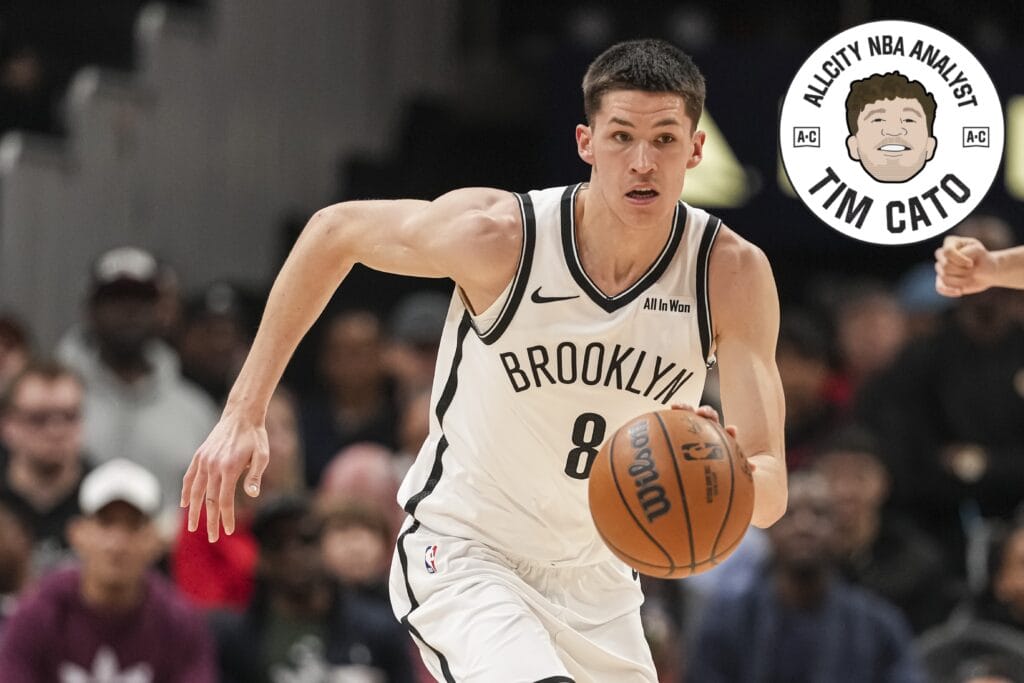
UP: Egor Dëmin, Brooklyn Nets
The NBA’s sexiest archetype over the past decade has been the wing-sized point guard. These players aren’t just wings who can pass; we’re talking about Ben Simmons and Luka Dončić, about LaMelo Ball and Cade Cunningham, players who are matchup nightmares as a primary option who allows their coaches the flexibility to run jumbo lineups or survive playing someone shorter who lacks such creation skills. They peer over defenses, cracking them open from dimensions above where defensive hands reach. That has been the idea of Egor Dëmin, which he inconsistently showed last season, especially inside the arc, where he made more 2-pointers (55) than played games (52). To be one of these players, you must still score.
Across four summer league games, Dëmin was consistently too good for his competition. He averaged about 24 points despite hitting only 28 percent of his 3s, which is fantastic for him. Dëmin has proven he can shoot in the NBA; he hit 39 percent of his 3s last season while taking 6.2 per game. More than a third of those (2.3) were off the dribble, which he converted at a 35 percent mark, which matters: Big guards like him leverage and create space behind the arc due to the constant pull-up threat they pose. But Dëmin will have his ceiling capped if he can’t score inside the arc, something that had come much easier for him this summer league than last year’s, where he averaged only 11 points per game.
Dëmin has been a plus passer and has better used his size, even nabbing a putback dunk before Brooklyn shut him down. Whether his 2-point shooting translates to his sophomore season, we’ll see, but Dëmin did what he could in Las Vegas this summer to prove he’s progressing exactly how the Nets have hoped.
DOWN: Noa Essengue, Chicago Bulls
While Caleb Wilson has proven himself above and beyond already lofty expectations, as Leger and Mares discussed above, Chicago’s first rounder from last year’s draft unfortunately has not. Essengue, selected No. 12 overall in 2025, missed all of last season after undergoing shoulder surgery. While drafted somewhat as a project, at least when it came to his body being NBA ready, Essengue has actually grown since being drafted — he was 6’8 when drafted but is now listed by the Bulls as 6’11 — but hasn’t matched that with the requisite strength needed to compete in summer league, much less the NBA itself.
Essengue was benched in the second half of the Bulls’ second summer league game, with his new coach Thiago Splitter telling reporters he “wanted more” from the second year big man, and his bench demotion carried over to the third game, playing just 17 minutes. It wasn’t all bad: Essengue’s potential was most visible at times on the defensive end, where his mobility and hands created splashy moments. Essengue isn’t ready, though, to earn any sort of rotation role starting next season without more improvement. That’s what his coach thinks, anyway, a damning assessment of his current status.
UP: Tre Johnson, Washington Wizards
UP: Will Riley, Washington Wizards
Washington might have had Las Vegas’ most stacked summer league roster: A.J. Dybantsa has been the star, and he has looked closer to Giannis Antetokounmpo than Brandon Ingram, which directionally is how we should hope his development goes. (He’s not Antetokounmpo, of course, but he makes more sense as an unstoppable paint attacker than a tall mid-range shooter.) But Washington’s two second-year lads, both who had marginal cases to even play summer league in the first place, quickly showed themselves as Too Good For Summer League candidates. Given that, it makes sense they played one and two games each, respectively.
I watched Johnson’s summer league debut-slash-coda; he shot 11-of-20, and I’m barely sure where those nine misses came tracking it with my own eyes. He was the best player on a court with Darryn Peterson and Dybantsa, flashing both his infinite range and on-and-off-ball abilities. Riley, another player who has grown since the draft, again from 6-foot-8 to about 6-foot-10 like Essengue, is a do-it-all wing. His streaky jumper is his primary question, but Washington might’ve spawned another Kyshawn George alongside the one they already have.
The obvious question for Washington next season: Are we sure Trae Young and Anthony Davis should even be taking up space that could be allotted to these very talented youngsters?
DOWN: Ryan Nembhard, Dallas Mavericks
Last season, Nembhard was an oasis to the Mavericks‘ guard-starved roster, one which often forced then-head coach Jason Kidd to run Cooper Flagg as the team’s primary ball handler simply due to the lack of any alternatives. Nembhard ended up playing 60 games, starting 27, and even recorded 23 (!) assists during the Mavericks’ meaningless final game. His play earned him a conversion from a two-way contract to a standard one late in the season.
Nembhard will probably make the Mavericks’ roster to being next season, but his roster spot shouldn’t be seen as guaranteed after his shockingly poor summer league, averaging about 13 points on 34.6 percent shooting from the field and 12.5 percent from behind the arc. Dallas came to Las Vegas with a fairly impressive roster, and Nembhard’s actual NBA experience should’ve made it click. Instead, the undersized point guard has looked bothered. If Dallas needs a roster spot this summer, it wouldn’t be a shock if he was let go to create it.
UP: Khaman Maluach, Phoenix Suns
Maluach was the largest human I saw in Las Vegas. Holy hell, he’s enormous.
The NBA has many such humans, of course, and Maluach must translate his stellar summer league to actual regular season basketball, something he barely was even given any chance to during what was essentially his redshirt season playing sparingly off the bench for Phoenix. But players even larger than him have washed out of the NBA because they couldn’t make their size felt. (Aday Mara, I’m worried how it looked for you.) Maluach was felt. He bullied his peers at this level. It was overwhelming, and he also did this while his 3-pointer fell to the tune of eight makes in 20 attempts. If his fluidity and athleticism keep matching one another, he doesn’t need that 3, but it’s sure nice to have.
But don’t listen to me. Listen to Legler.
DOWN: Nique Clifford, Sacramento Kings
Clifford was a late first rounder, but his selling point when Sacramento drafted him No. 24 overall in 2025 was that he was NBA ready. When Sacramento marched to the 2025 Summer League championship game, losing to the Charlotte Hornets and Kon Knueppel, he was a primary reason why while averaging about 15 points on 48 percent shooting from the field and 46 percent behind the arc. But Clifford’s rookie season was far more underwhelming despite appearing in 75 games; he averaged fewer points, rebounds, and assists this summer than last year’s on worst efficiency despite similar minutes. For any other player entering his second season, this wouldn’t be an enormous deal. For Clifford, he’s already 24 and needs to prove more now.
UP: Yang Hansen, Portland Trail Blazers
Hansen had worried me. It’s unfair to slap him with the Jokić label but hard to find better comparisons than that, which obviously influenced why he was drafted. I still worry about his overall athleticism, if he’ll ever be something more than a backup hub big who can run some offense as a second look. But we have been begging to even see flashes from him.
There are sure some flashes in these highlights.
Tim Cato is ALLCITY’s national NBA writer currently based in Dallas. He can be reached at tcato@alldlls.com or on X at @tim_cato.