

The 2026 NBA offseason hasn’t concluded, although LeBron James’ Final Decision last month, as it’s been coined, has brought us closer to the end. The main names remaining: Jalen Duren, DeMar DeRozan, Benedict Mathurin, Peyton Watson, Jonathan Kuminga, Bradley Beal, and Dwight Powell, of course, whose next homes will be sorted out in the weeks to come. But we’re through 90 percent of what we expect from this offseason.
In light of that, here are some of the most underrated and under-the-radar moves we’ve seen this summer.
Philadelphia acquiring Dean Wade and Anfernee Simons
As you know, LeBron James has joined the 76ers. There have been a dozen behind-the-scenes stories that detail how and why he chose them; there have seemingly been even more about his potential helicopter commute. Philadelphia’s Jaylen Brown, it’s said, was one driving factor for his addition. But Philadelphia’s smart work outside of its splashiest moves, while perhaps not James’ reason, deserve notice.
Between James and Joel Embiid, we should expect the 76ers’ starting five — certainly Tyrese Maxey, VJ Edgecombe, Brown, James, and Embiid — won’t always be whole. Embiid will miss time; James’ season should be seen as a seasonlong project to maximize him for the postseason. That’s where Philadelphia’s depth comes in: Smart additions this offseason included Dean Wade, the 6-foot-9 defensive wing who can moonlight as a center in a pinch and cover up regular season absences, and Anfernee Simons, a blisteringly accurate shooter who hit about 43 percent of his catch-and-shoot 3s last year while also finishing as a top-30 pull-up shooter, too. These are more than minute-eaters, but they will cover and spot for the minutes Philadelphia enters the season knowing will be needed eaten.
San Antonio re-signing Julian Champagnie
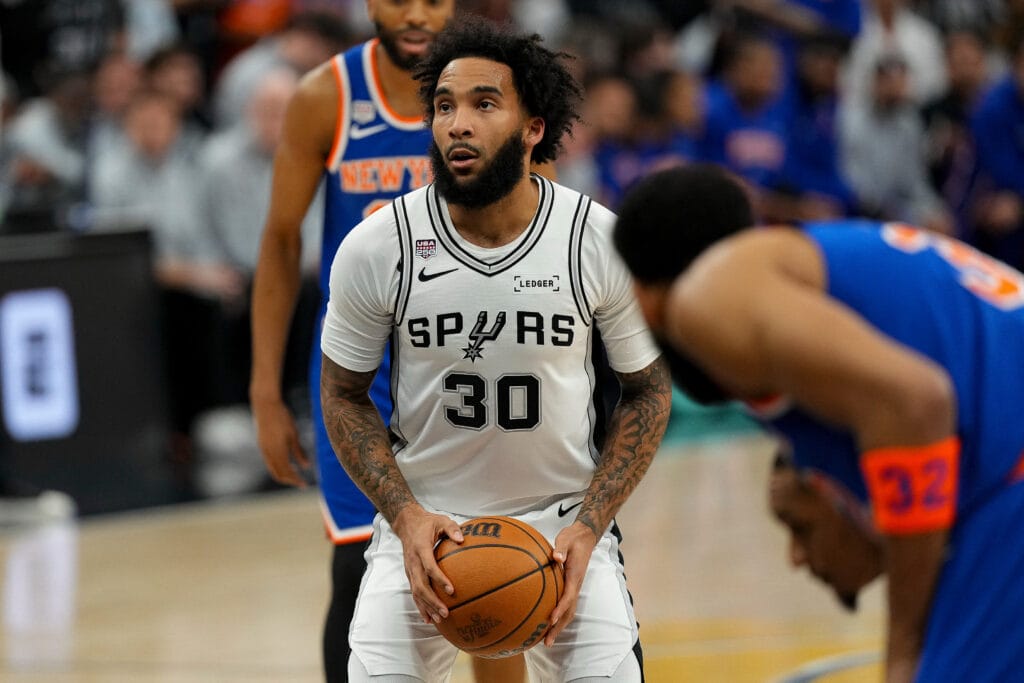
The Spurs both are a title contender and ahead of schedule; how else can you parse a team led by a 23-year-old superstar and 22-year-old and 20-year-old guards that just reached the NBA Finals? The team didn’t revamp its roster, didn’t need to. The primary additions — three drafted big men and Tobias Harris as something of a better veteran replacement for Harrison Barnes (who they also re-signed!) — were more or less statements of this: We like our roster and we don’t think we need much outside help. To that point, the team’s No. 20 selection in the June draft, Jayden Quaintance, might not even play this season.
But the team’s savviest move this summer was re-signing Julian Champagnie, the role player who started every game after Dec. 31 who averaged about 12 points on 62 percent True Shooting this past postseason. The team locked him up for the next three seasons for about $45 million; it’s a declining deal that, in the 2028-29 season, the year Stephon Castle’s extension will kick in and a season before Dylan Harper’s does, for just eight percent of the projected salary cap. Even if Champagnie doesn’t remain a locked starter for the team, that’s excellent role player money for the superb role player he is.
Atlanta nabbing Aaron Wiggins for nothing
The Oklahoma City Thunder are too good for their roster; it was inevitable the team would have to shed some would-be rotation players good enough for most team that isn’t theirs. Aaron Wiggins was one such example: He played more than 1,400 minutes in the regular season for them but only 75 in the postseason, a tiny number for a player who admittedly had a down year but has proven to be an efficient scorer through his career he’s spent entirely in Oklahoma City.
Atlanta also acquired Lu Dort from Oklahoma City, who is more of the direct replacement for the outgoing Jonathan Kuminga, a player who Atlanta leaned on in its first-round defeat to the eventual champion New York Knicks. But Wiggins, acquired for a couple distant second-rounders, adds shooting depth to a roster that needed and still needs more of that.
Detroit acquiring Isaiah Joe
The Pistons made a fairly parallel move swapping out the aforementioned Harris for John Collins: They aren’t the same player, but they both are bigger wings who shoot and offer certain contextualized scoring punch in their own ways. (Collins is slightly larger, a four who can play the five vs. Harris’ four who can play the three.) In that sense, with Duren’s restricted free agency presumably sending him back to Detroit at some point sooner or perhaps likelier later, the Pistons saved their draft capital ammunition for another move to come.
That said, while Detroit does still have Duncan Robinson and did retain Kyle Huerter on a relative cheap three-year deal worth $27 million, we know the Pistons needed more shooting. Despite having one of the NBA’s best 3-point shot creators in Cade Cunningham, they took the second-fewest in the regular season due to the spacing concerns that exist within lineups often featuring two of Duren, Ausar Thompson, and Ron Holland II, all of whom are virtual non-shooting threats. Enter Isaiah Joe, another Oklahoma City castoff who featured in the regular season (a bit more than 1,500 minutes) but not the playoffs (just 143 total across three rounds).
Joe has converted almost 42 percent of his 3s over the past four seasons; he’s genuinely one of the league’s more feared shooters, a thing that Huerter has not been despite past precedent. It’s a nice add; it’s possible he even starts.