
You can’t stop an NBA superstar from scoring.
This is the basic principal every team accepts when preparing its strategy to defend another team. Your best defender can sometimes win one-on-one possessions. You can bother opposing stars, you can speed them up, you can hope for an off night. But the league’s elite players, and nearly every team in this year’s NBA postseason have one, are too god-like at this sport to stop outright.
That’s why, in this postseason’s first round, it’s become increasingly common to see cat-and-mouse tactics designed around the only foolproof strategy that can stop them from scoring: That they can’t if the basketball’s not in their hands.
Ball denial, obviously, has existed for as long as this sport has. Every strategic example we’ll point out from the past week’s first-round games was used throughout the regular season and for many seasons before this one. It’s the frequency that has risen, at least to my eye, which was backed up by two assistant coaches I shared this observation with. It can be partially explained by how officials have adjusted their whistles since the postseason began.
“I feel like you can get away with anything off the ball,” one told me earlier this week. “It doesn’t make sense to guard any other way.”
This is how defenses are going to greater lengths since this postseason began to prevent the league’s best players from beating them.
Ball denial starts with the star’s defender
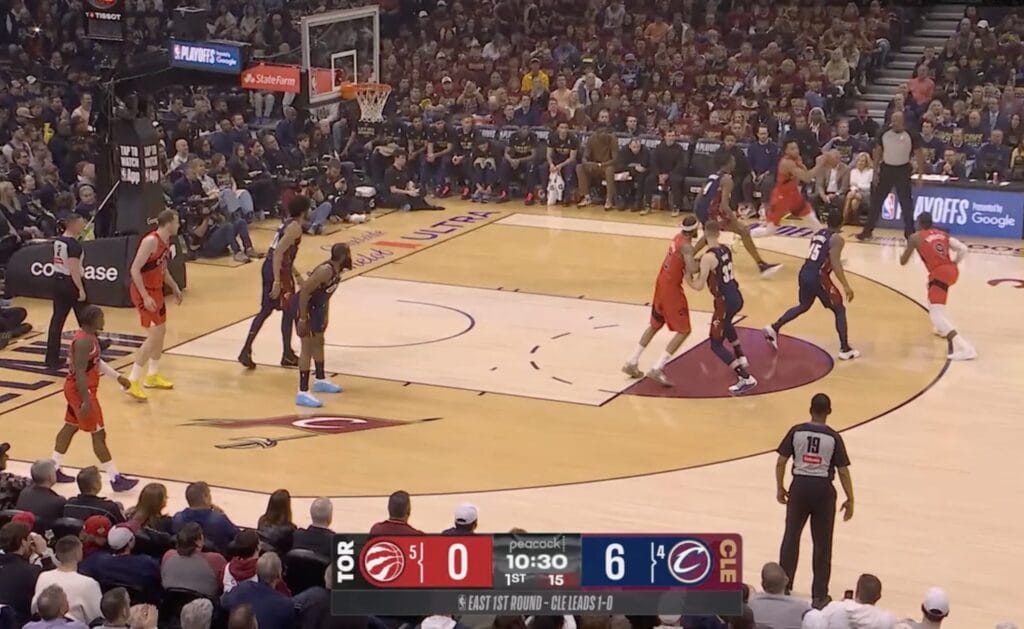
Let’s start with this possession from the second game of the Cleveland Cavaliers and Toronto Raptors’ first-round series.
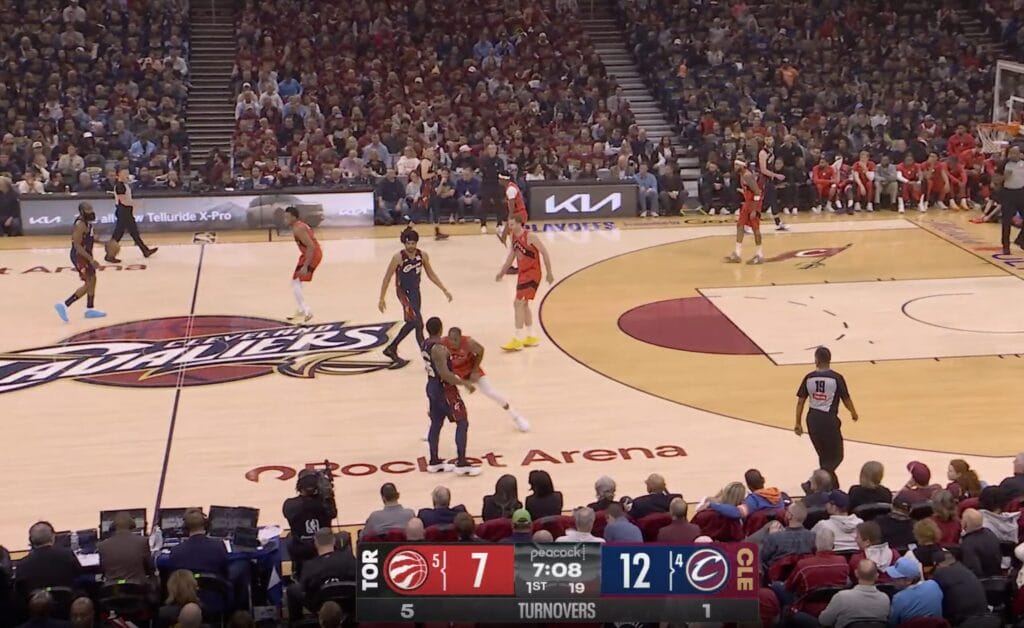
This is man-to-man defense, but this split-second screenshot could be briefly confused for a box-and-one zone. Toronto’s RJ Barrett has been tasked with face guarding Donovan Mitchell, which means exactly what it sounds like. While his teammates slightly sag off their assignments, Barrett isn’t even facing towards the ball as it crosses the halfcourt line in James Harden’s hands.
Through two games, Toronto head coach Darko Rajaković has often had his team set its defensive shape nearer halfcourt than the average regular season outing. The Cavaliers’ offense runs through its two star guards, who use that space above the 3-point line to set up the team’s actions. Toronto wants to force those screens to be set higher. It’s not uncommon, like the screenshot above, to spot three or even four Raptors defenders positioned beyond the arc to disrupt those actions. In a sense, to use a soccer analogy, it’s similar to Barcelona’s high-line defense, which collapses how much space opponents can work with even if it leaves room behind.
Cleveland, who leads 2-0 in the series, has beaten that gambit on possessions like this one.
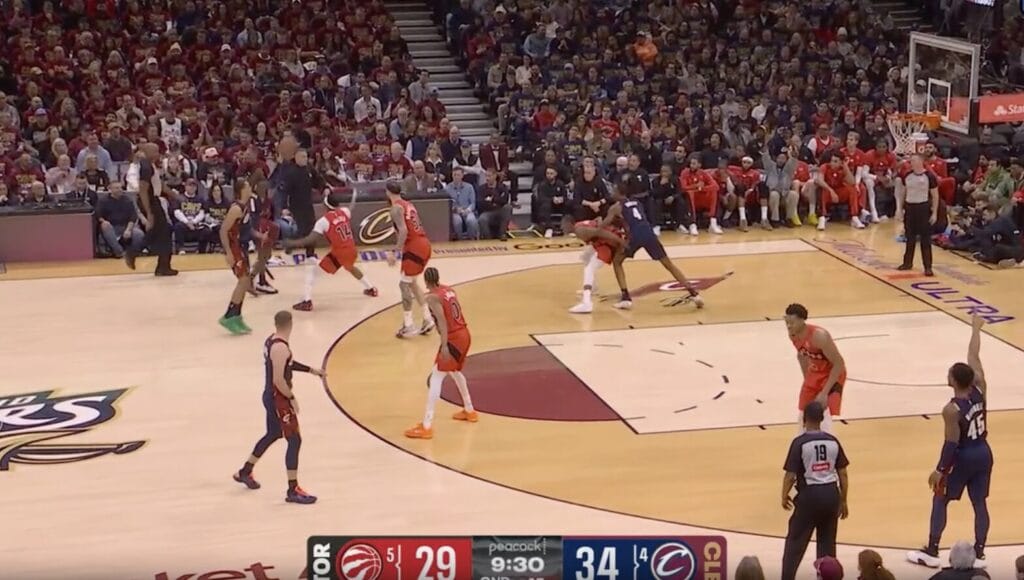
Dennis Schröder, who’s nearest the scorer’s table in this screenshot, is passing this basketball over the top to Evan Mobley, who will finish this play with an uncontested dunk. (Mitchell’s even pointing out this pass in the corner.) But Toronto seems to have determined possessions like this are a necessary risk, that it’s more important, as the underdog, to instead disrupt Cleveland’s freedom of movement above the arc than to guarantee there’s always someone near the rim.
Cleveland has deployed the same strategy against Brandon Ingram, who attempted just nine shots in the series opener and shot a disastrous 3-of-15 from the field in Monday’s Game 2. On the possession below, Dean Wade is top-locking Ingram in the court’s center, a strategy that requires the defender to disrespect defending’s first, most fundamental rule: Staying between your assignment and the basket.
Cleveland’s set up better defensively on this possession; Jarrett Allen is a rotation away from disrupting that pass behind Wade that Cleveland’s daring Scottie Barnes to throw if Ingram cuts. Instead, this possession ends with Ingram wrestling with Wade for better possession and missing an elbow jumper, and wrestling is the right term. On the game’s second possession, Wade was whistled for his near-romantic entanglement with Ingram off the ball.
This was one possession before the earlier screenshot, but Wade was not deterred by that initial warning. As the assistant coach told me, it does feel like “you can get away with anything” now that the postseason’s begun. Wade played 27 more minutes in Game 2; he was whistled for only one more foul.
Kevin Durant received this same treatment from the Los Angeles Lakers in the second game of their series against the Houston Rockets on Tuesday. It’s amusing how seamlessly Smart and Rui Hachimura exchange this responsibility when Amen Thompson runs around Durant’s entanglement, triggering the off-ball switch.
This was the first possession of Game 2’s second half. In the first 24 minutes, Durant had made six shots on seven attempts, which triggered halftime adjustments from Lakers coach JJ Redick. In the second half, Durant went 1-of-5 with five turnovers once the entire Los Angeles strategy coalesced around him.
Let’s return to that Mitchell-being-guarded-by-Barrett screenshot we began with this reminder: You of course can’t deny stars the ball forever. This is what ultimately happened on that play.
Like I said: You can’t always stop superstars from scoring.
How to smartly send another defender at a star
Guarding opposing superstars with one defender isn’t the right number. In a perfect world, you’d like two, perhaps three, even four to be sure. Unfortunately, the math doesn’t work like that. For every double team sent, a defense risks exposure. Take these two halfcourt traps that Toronto sprung on Mitchell. In the first one, it blew up Cleveland’s entire planned possession. By the second half, when the Raptors tried it again, Mitchell was prepared for it and Cleveland generated an open corner 3.
In the modern NBA, teams do still blitz pick-and-rolls, the coverage where the screener’s defender joins his teammate in a double team meant to overwhelm the guard and, ideally, force turnovers. (You’ll most often see this paired with the sideline as a third defender.) Increasingly, though, teams won’t commit to true double teams, especially since most stars can capably solve them, and instead shade help towards a player to induce them into passing.
This isn’t rocket science; I trust nearly everyone reading this understands these concept. But this example from Toronto checks nearly every box we’ve discussed: The Raptors shade Scottie Barnes towards Mitchell in another moment where its man defense resembles zone. (This time, it looks like a 2-3 zone; if you’ve heard coaches or media members talk about ‘zone principles’, this is what they mean.) Mitchell doesn’t touch the ball again before Sam Merrill’s bad pass turnover against a fronting defender that had conceded space behind him.
This would be riskier if Harden was on the court in Schröder’s place, or if Cleveland adjusted to put Sam Merrill or Max Strus, who simply might have taken that initial shot, above the 3-point arc as Mitchell’s release valve. But Toronto trusts that Barnes, who’s at minimum one of the league’s 10 best defenders, can stunt and recover back to his assignment without the team’s defensive shape breaking.
For Los Angeles, this stunt-and-recover scheme was made easier because the Rockets have so few shooters. (And because Ime Udoka doesn’t like playing his second-best one, too.)
Watch Marcus Smart, initially face-guarding Durant before an off-ball screen forces him to switch, point out every single rotation he needs his teammates to make. He even dictates the first rotation to LeBron James, and the defenders around him seamlessly slide back into place on different assignments. This is a great possession to showcase how defensively brilliant Smart still is.
We’ve covered only small fractions of the defensive complexity involved in the modern NBA. But once you’ve seen these examples, you’ll probably start noticing them in every game you watch. What matters in a basketball is what happens with the ball, but the lawlessness we’ve seen with increasing frequency away from the ball has become its own game inside of a game.
Tim Cato is ALLCITY’s national NBA writer currently based in Dallas. He can be reached at tcato@alldlls.com or on X at @tim_cato.