© 2026 ALLCITY Network Inc.
All rights reserved.


This week, we’re taking a hard look at three teams: the Oklahoma City Thunder, whose struggles against the San Antonio Spurs has morphed into the most vulnerable play we’ve seen from them in almost two years; and the shared success of the Phoenix Suns and the Boston Celtics, who have both shocked the league with dangerous offenses far above expectations and have done so, it turns out, with awfully similar approaches to that side of the court.
The Oklahoma City Thunder have lost six of the team’s last 13 games, a slight deviation that has now gone beyond the team’s three consecutive defeats to the San Antonio Spurs. Even while notching another win earlier this week, the Thunder needed overtime to secure it against the Utah Jazz, a highly competitive team that still falls well short of Oklahoma City’s elite atmosphere.
Oklahoma City remains the league’s standard bearers, and that’s not just because they’re the league’s reigning champs. They still have the league’s best defense and point differential. Even during this 13-game slump, they’ve still had the league’s fourth-best defense and sixth-best net rating. Half of those defeats came against San Antonio, of course, which has specific matchup advantages we examined last month. (We’ve got another matchup between these two squads next week.) As Jalen Williams said following the Utah clash, Oklahoma City is allowed to have missteps.

“I don’t want this to sound cocky, but the last three years, we’ve won so much,” he told reporters. “When we have a normal human stretch of losing a game or two that we shouldn’t have lost, the world freaks out.”
But Oklahoma City, in this stretch, have reminded the league that they aren’t invincible. The team’s 21-1 start to this season, which nearly prompted league-wide doomerism, came against a softer schedule than we perhaps realized at the moment. (Eighteen of those 22 games were against teams currently below .500.) Don’t underestimate the Thunder; don’t start believing that they’re not still the league’s scariest team. But here are some cracks in their armor worth noting.
1. Oklahoma City’s inconsistent shooting has been exploited
Since this 13-game stretch began, the Thunder have the league’s fourth-worst 3-point shooting as a team (31.8 percent). The numbers are worse on catch-and-shoot 3s, too, falling to 31.2 percent. Alex Caruso, Cason Wallace, and Aaron Wiggins have combined to knock down just 31 of their 115 long-range attempts (26.9 percent), and not a single player has shot above 40 percent across this stretch.
This has been one of Oklahoma City’s few flaws dating back to last season; it clearly isn’t fatal. But this inconsistent shooting has provided opponents more opportunistic ways to defend them. More opponents have assigned non-shooting labels to players like Caruso, Wallace, and Lu Dort.
That’s what the Phoenix Suns did in their win against them last week: Mark Williams spent most of his time against Dort, allowing him to stay low and nearer the rim more often. Dort took nine 3s, making three of them, but Williams was clearly comfortable letting him shoot. After airballing one 3 in the third quarter, Dort’s trigger grew shier, like this look he never even contemplated.
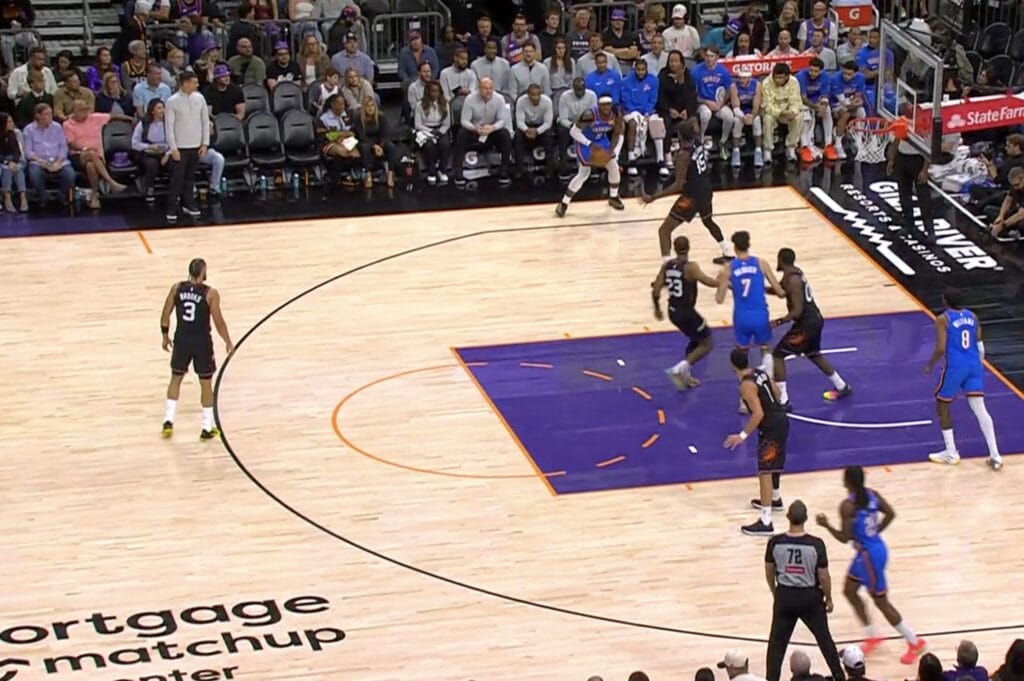
Dort has 12 career games with six-plus made 3s, including four last season. He’s proven he’s not in the same tier of non-shooter as Tony Allen; it’s not a bet that will always work. But as he’s shooting just 33 percent behind the arc this season, it is a strategy that’s working right now. And it’s possible because …
2. Chet Holmgren doesn’t consistently exploit smaller matchups
Holmgren makes these tactics possible because he’s not a matchup nightmare when teams guard him with smaller players, at least not yet. At their best, the Thunder offer opponents five-player lineups without weaknesses on either side of the court. But when Dort or Caruso can be ignored, it minimizes Holmgren, too, who can’t shoot over smaller players who crowd him or consistently drive past them, either.
Mark Daigneault briefly took Holmgren out in the fourth quarter of the team’s defeat against the Suns. It was shortly after this play, a near-turnover when he attempted to post up a smaller player. (In complete fairness, Holmgren did win this jump ball and the possession resulted in a made Thunder 3.)
Still, it’s clear the Thunder offense can be made less efficient when opponents can get away with guarding them in this manner. Holmgren’s incredible; I’m not doubting his ability to learn how to punish these choices, like Kristaps Porzingis has, in due time. And when the Thunder role players are making 3s, it’s a less functional strategy. (The same thing applies to Oklahoma City’s struggles last postseason against zone defense.) But the Suns dared the Thunder to play through Holmgren, and it worked.
Holmgren isn’t a strong offensive rebounder, either, which is the other way big men can punish the humiliation of a smaller assignment. That’s one area where Isaiah Hartenstein’s absence can be seen.
3. The Thunder’s defense just hasn’t been as sharp
If Oklahoma City begins nailing 40-plus percent of its 3s again, which it did for the majority of the team’s 22-1 start, these strategies become less viable. In other words, the team’s flaws, at least against teams not named the Spurs, are completely within its own control.
The same thing applies to the team’s defense, which has been spacier in recent weeks than we’re accustomed to seeing them. Like this possession, where Dort stops tracking an open man to glare at Devin Booker even though Holmgren’s positioned at the rim. Staring menacingly at an opponent, it turns out, is not a coach-approved tactic for help defense.
Oklahoma City has had more defensive lapses than is typical to them in the past few weeks. This is where we come back to the reality described by Jalen Williams: This is the league’s best team, but even they accept they’re still mortal, vulnerable to the season’s dog days especially after providing a championship effort for 100-plus games last year. These lapses have helped opponents add some blemishes to the Thunder’s record; it’s still, ultimately, within their control.
4. Williams isn’t (yet?) himself
If there’s any actual long-term concern, it stems from Williams’ play since returning from his offseason wrist surgery. He’s just not quite the player he was the past two seasons: less efficient at the rim and on long jumpers, heavily reliant on pull-up 2s in and around the paint. I wouldn’t bet against him, either, but it’s their foremost long-term storyline worth monitoring.
The Celtics and the Suns have been their respective conference’s most surprising teams and, in both cases, it’s their offenses that have most outperformed expectations. Boston sits alone atop the league in offensive rating (124.4 points per 100 possessions); Phoenix has climbed to 12th overall despite Jalen Green playing just two games this year.
Earlier this week, I wrote about the Suns’ success, which they’ve achieved despite hardly ever generating shots at the rim:
Phoenix turns just one out of every four shots into a layup or a dunk. They have the league’s 29th-worst rim attempt rate (25.7 percent), a statistic better but reminiscent of last season, where the Suns finished dead last (21.7 percent), a calamitous season that led, of course, to the departures of Kevin Durant and Bradley Beal. That alone should have made Phoenix’s offense worse before factoring in Jalen Green’s extended absence, which has limited him to just two games.
But it hasn’t. Phoenix’s offense this year, good for 114.6 points per 100 possessions, is just a fraction away from last season’s (114.7).
There’s just one team that takes fewer shots at the rim than Phoenix. It’s the Celtics. Look at how eerily similar these two team’s offensive profiles are:
| PHOENIX | BOSTON | |
| RIM% | 29th | 30th |
| FTr | 29th | 30th |
| OREB% | 5th | 6th |
| 3PTr | 9th | 2nd |
These two teams don’t take layups, they don’t shoot free throws, and they love 3-pointers. They both have success with turnovers, just on different ends of the court: Phoenix turns opponents over more than any team not named Oklahoma City; Boston commits fewer turnovers than the rest of the league except for, you guessed it, the Thunder. Both teams’ offenses are helmed by mid-range maestros, Devin Booker and Jaylen Brown, which has resulted in Boston taking the league’s second-most mid-range attempts per game and Phoenix ranking eighth.
And even though these jumpers each team takes will clank off the rim more often than the shots they don’t create, that’s fine. Because it meshes synergistically with the real reason behind each offenses’ success: They crave missed shots, they hunt them down, and they do it with obvious intent.
The Houston Rockets and the Detroit Pistons lead the league in offensive rebounds, and both squads do so by stacking their lineups with size and monstrous physical force. That doesn’t describe either team we’re discussing: Boston’s lineups are, on average, the second-smallest in the league; Phoenix’s are ninth-smallest. Instead, it’s sheer intention that earns them these second chances. Look at where each team ranks in the number of players it sends to the glass:
| PHOENIX | BOSTON | |
| Avg. crashers | 1.3 | 1.2 |
| Avg. crashers rank | 1 | 3 |
| 2+ crashers | 54.4 | 50.8 |
| 2+ rank | 1 | 3 |
| 3+ crashers | 23.5 | 16.7 |
| 3+ rank | 1 | 4 |
Phoenix sends three players to the glass about 24 times per game; the Cleveland Cavaliers, where Suns head coach Jordan Ott spent last season as a lead assistant, are the only team in the same universe as them (about 23 times per game). Boston isn’t as aggressive as Cleveland, but they rank third behind Phoenix and Cleveland in the average number of crashing players on any given possession. Both teams have non-centers within the league’s top-25 in offensive rebound rate: Jordan Goodwin for Phoenix, the shortest player in that stat’s top-40, and, for Boston, Jordan Walsh.
These teams must leak fast break points, then, right? That’s the old mantra that led to offensive rebounding being deprioritized for a decade-plus in the league. Well, no. Boston allows the third-fewest transition points; Phoenix ranks fifth. Remember: These teams don’t take shots at the rim. In other words, they lead the league in the fewest number of missed layups, which has always been the action most likely to result in a successful fast break going the other way.
It’s a new-age strategy for basketball’s ever-evolving game and, for both teams, it’s defying the expectations we had for both teams.
I loved this back tap from Ryan Dunn, who sent the ball towards his own rim just because there were no opponents down there to secure it.
Crew chief Curtis Blair really made a meal out of these two moments, following jump balls, to moonlight as a soccer referee who just exists in the center of the pitch.
I can’t say I’ve ever seen this, much less twice in a single game.
Tim Cato is ALLCITY’s national NBA writer currently based in Dallas. He can be reached at tcato@alldlls.com or on X at @tim_cato.


